Traditional fired brick is more resistant to erosion than some modern pavers. Locally sourced slates exhibit a longevity superior to most composite materials. Yet, the rise of industrial solutions has often relegated these traditional choices to the background, despite their proven durability.
In light of environmental challenges and the search for character, many individuals are reevaluating the fundamentals of outdoor landscaping. Techniques and materials from the past, adapted to contemporary uses, provide concrete answers that are both aesthetic and responsible.
Understanding the spirit of an authentic garden: harmony, simplicity, and respect for the environment
An authentic garden does not seek to impress with its artifice: it imposes itself discreetly, in constant dialogue with nature. Here, every plant, every stone, every nook aims for balance. Far from sterile alignment, diversity prevails: ladybugs, blue tits, hedgehogs find their place throughout the seasons. An ecological garden is primarily a space that relies on biodiversity, where local species and plants suited to the land, sun, or shade of the place are prioritized.
To ensure daily life can be lived without constraint, it is better to organize the garden into several well-thought-out spaces:
- A corner dedicated to rest, to enjoy the calm.
- A zone of varied, abundant, and lively vegetation.
- A practical space for maintenance or composting.
This layout, inherited from the know-how of landscapers, serves a dual purpose: to make the garden pleasant to live in and coherent in its structure. Simplicity guides every choice, even in the selection of grass or alternatives:
- Replace traditional lawn with a flowering meadow or ecological grass for less watering and more life.
- Install ground cover plants that enrich the soil and limit maintenance.
Look to labels like Fleurs de France or Plante bleue: they guarantee the origin and ecological commitment of the plants. On the site traditionjardin.fr, these markers are highlighted, accompanied by practical advice designed for garden lovers who leave nothing to chance. Landscape professionals agree: authenticity arises from the coherence between materials, plants, and daily uses. The result is a space that follows the rhythm of the seasons, inviting relaxation and observation, without ever falling into monotony.
Which traditional materials to prioritize for a sustainable and aesthetic layout?
Creating an authentic garden requires questioning the origin, durability, and impact of the materials used. Experienced landscapers recommend several major categories to structure and enhance the spaces:
- Wood
- Patinated metal
- Natural stone
- Terracotta
Local wood, sourced from responsibly managed forests, allows for the creation of fences, borders, or furniture that withstand the test of time without losing beauty. Stone, whether granite or slate, is used to build walls, design paths or terraces, while integrating into the history of the place.
Here are the advantages of the main materials to prioritize:
- Ecological materials: raw wood, regional stone, untreated terracotta, recycled metal.
- Living materials: plant mulch, fallen leaves, pruning residues to nourish and protect the soil.
- Recycled materials: reused wood, aggregates, recycled plastic for certain occasional uses.
Grass pavers and cellular pavers promote water infiltration and protect the soil from excessive sealing. Gravel stabilizers allow for the creation of paths without resorting to concrete, and recycled sculptures or solar lights provide a modern touch without betraying the spirit of the place.
The choice of materials makes sense when considering their origin and method of transformation: prioritizing stone extracted a few kilometers away, wood processed in a local sawmill ensures the longevity and aesthetics of the whole. Simple lines, the patina of time, and natural textures enhance the garden’s identity, far from standardized products. It is better to focus on sobriety and coherence, relying on practices and materials that have proven their worth.
Concrete ideas for combining plantings and materials according to different garden styles
An authentic garden is rooted in the local landscape. The choice of native plants is not trivial: they withstand climate fluctuations, require less watering, and need few treatments. In the shade, camellias and hydrangeas thrive, while in full sun, lavender and santolina shine without faltering. Promoting biodiversity also involves installing dry hedges, insect hotels, or birdhouses: fauna then naturally invites itself and regulates small imbalances.
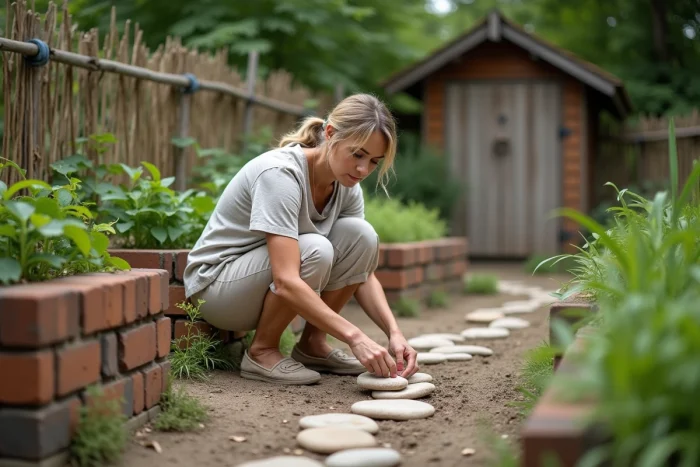
For resting areas, nothing beats small separations made of stone or wood, which delineate without enclosing. A dining area can be set up under a chestnut pergola, while a path of Japanese stepping stones in slate discreetly connects the different corners of the garden. In areas where children play, prioritizing ecological grass or ground cover plants ensures good resistance to trampling.
Here are some combinations suited to different styles of ambiance:
- For a contemporary garden: prioritize grasses, graphic perennials, combined with stone or granite.
- For a Japanese-inspired garden: bamboo, maples, moss, combined with pebbles, lanterns, or small natural ponds.
- For a country garden: flowering shrubs, aromatic plants, gravel paths bordered by bricks or wood find their natural place.
Mulching proves to be a significant ally: mulch, leaves, pruning residues protect the soil and limit evaporation. Compost and peat-free potting soil nourish the earth and avoid chemical fertilizers. To enhance it all, discreet nighttime lighting, ideally solar, highlights the raw beauty of the materials while respecting the garden’s nocturnal life.
Creating a garden that endures through the years means choosing patience, betting on authenticity, and celebrating the meeting of timeless materials and living nature. Over time, each nook gains character and tells, in its own way, the story of the place and those who inhabit it.