
You order a serum spotted in an advertisement, and it arrives three weeks later with slightly different packaging and a truncated INCI list. This kind of mishap is leading more and more buyers to structure their approach before validating an online cosmetics cart. Choosing beauty products online relies less on intuition and more on a few concrete reflexes that are easy to implement from the first order.
Check the seller and batch number before adding to cart
Before even looking at the composition or price, you save time by checking who is actually selling the product. On major marketplaces, the same product can be offered by the official brand and by several third-party sellers whose origin remains unclear.
The DGCCRF published warnings in 2023 regarding the online sale of non-compliant cosmetics: incomplete labeling, missing INCI lists, misleading claims. Their recommendation is clear: favor sites that identify the manufacturer and the shipping country. A seller who does not display this information on their product page deserves suspicion.
Specifically, you can check three elements in a few seconds: the seller’s name (brand or authorized distributor), the shipping country, and the presence of a batch number on the product image. A cosmetic shipped from a third country without mention of European compliance is a red flag.
This last point, the batch number, allows for traceability in case of a skin reaction. When you start to explore Cosmetics Beauty online, these checks quickly become automatic and filter out the majority of dubious products.
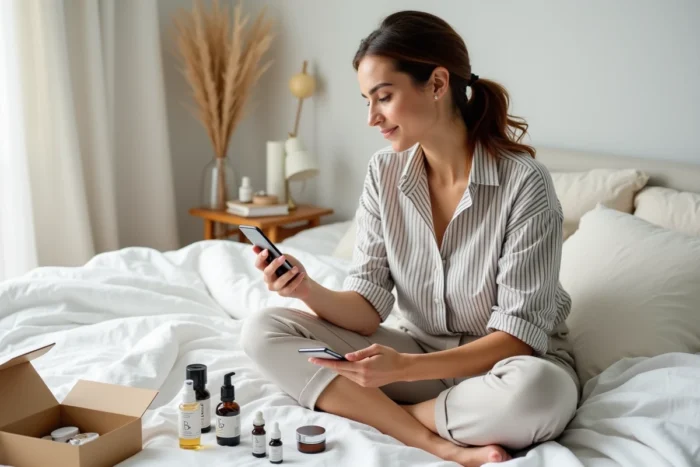
Decoding online cosmetic reviews: filters by skin type and biases to spot
Customer reviews remain the primary source of trust for an online beauty purchase. The problem is that a positive review on a moisturizer means nothing if the person who wrote it has oily skin and yours is dry.
Several platforms now integrate review filters by skin type, phototype, or age. This feature radically changes the relevance of the feedback consulted. For a foundation, filtering reviews by skin tone allows you to obtain photos and descriptions suited to your own situation, rather than sifting through hundreds of generic comments.
Spotting unreliable reviews
A review written on the same day as the delivery of an anti-aging product has no practical value. For skincare, we look for feedback posted at least two to three weeks after receipt. Reviews that describe a complete routine (cleanser used beforehand, frequency of application) are generally more useful than those that limit themselves to “great product, I recommend.”
- Check the date of the review against the purchase date: a gap of a few weeks indicates a real experience
- Look for reviews accompanied by unretouched photos, especially for makeup (foundations, concealers)
- Beware of perfect ratings without any details: the most useful feedback mentions at least one negative point or limitation of the product
INCI analysis apps: what they detect and what they don’t say
Scanning a barcode with INCI Beauty or Yuka before buying a cosmetic has become a reflex for many. These apps assign a score based on the composition and highlight controversial ingredients.
A global score does not replace targeted reading of the ingredient list. A cream may receive an average score due to a preservative classified as “moderate risk” even though it is perfectly tolerated by most skin types. Conversely, a well-rated product may contain an allergen that specifically concerns you.
Using apps as a filter, not as a verdict
The most effective approach is to use the app to quickly eliminate products containing substances you want to avoid (suspected endocrine disruptors, silicones, certain sulfates), and then manually check the two or three finalists. Feedback varies on this point, as each app uses its own scoring system, and the same ingredient may be classified differently depending on the database used.
- Yuka covers a very wide catalog but sometimes oversimplifies the scoring
- INCI Beauty offers a more detailed analysis ingredient by ingredient, with accessible scientific sources
- QuelProduit, developed by UFC-Que Choisir, cross-references the composition with public health data
- Clean Beauty positions itself on a stricter reading of so-called “clean” formulations
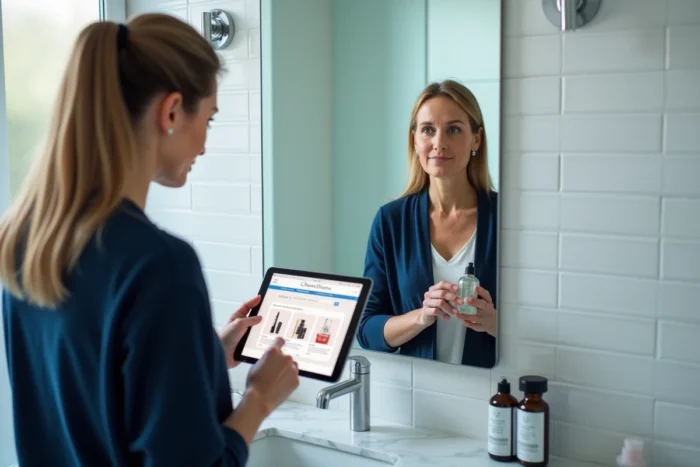
Environmental labels on beauty sites: beyond the word “organic”
The term “organic” on a cosmetic sold online does not guarantee much without verifiable certification. More precise labels are appearing on some European marketplaces: “Climate Pledge Friendly,” “Plastic-neutral,” or carbon footprint scores displayed directly on the product page.
According to the 2024 report from the NGO Zero Waste Europe, several European brands are already testing carbon footprint labeling by product on their online beauty shops. The Federation of Beauty Companies (FEBEA) also communicated in 2024 about compliance with new European obligations regarding environmental transparency.
For an online purchase, these labels help differentiate two products that are equivalent in composition and price. Checking if the label refers to an identifiable certifying body remains the only way to distinguish a real commitment from a mere marketing mention on the packaging.
Ultimately, choosing cosmetics online takes less time than one might think, as long as a few checks are systematized. Identifying the seller, filtering reviews by profile, scanning the composition, and reading labels beyond the word “natural” covers the vast majority of risks. The rest is a matter of skin, and that, no algorithm will completely replace.