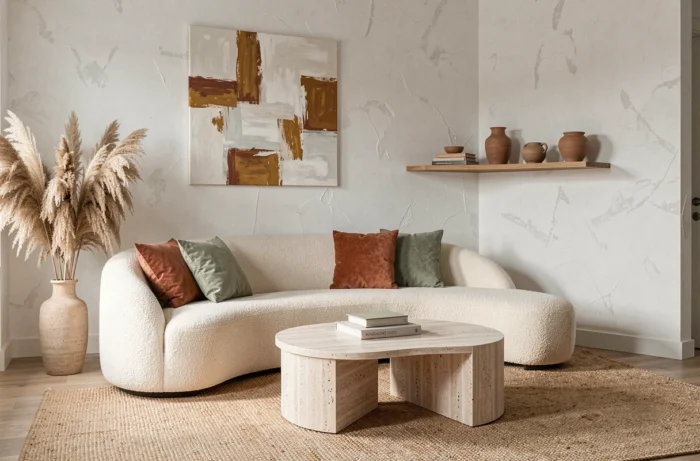
This year’s decor trends share a common thread: the search for interiors that can adapt to everyday uses without sacrificing aesthetic coherence. Low-processed materials, color palettes rooted in the territory, furniture designed to evolve with the home: the new decor items reflect a shift from decorative to sustainable functionality.
PEMD Diagnosis and Reuse of Decorative Materials: What the Regulations Change
Since September 1, 2026, the PEMD diagnosis (products, equipment, materials, waste) requires the identification of assemblies, traceability of materials, and assessment of their reuse potential. This obligation, which applies to renovation and demolition sites, has a direct effect on the interior decoration market.
Elements once destined for the dump (old parquet, cement tiles, solid wood joinery) are now entering a documented circuit. Reuse is no longer a matter of opportunistic DIY: it is part of a regulatory compliance logic. For an individual renovating, this means that a craftsman must now evaluate what can be preserved or refurbished before ordering new items.
This administrative constraint produces a tangible aesthetic effect. Interiors incorporate materials with a patina, irregularities, and a visible history. The result differs from the deliberately aged “reclaimed” style: here, traceability guarantees the actual origin of the material, giving it a documented value, not just decorative.
To keep up with these regulatory developments and their repercussions on design, the news from Just in Déco regularly covers these in-depth topics.
Artisanal Ceramics and Lime: Refuge Materials Against Standardization
The Maison&Objet 2026 fair confirmed the repositioning of artisanal ceramics as a refuge material. The term is not trivial: in the face of the saturation of smooth, uniform industrial finishes, handmade ceramic pieces reintroduce variation into interior decoration.
Specifically, this translates into wall tiles with irregular glazes, bathroom basins with slightly asymmetrical edges, or light fixtures whose surface grain varies from one piece to another. Each piece remains unique, breaking away from the catalog logic where everything looks alike.
The Return of Lime in Wall Finishes
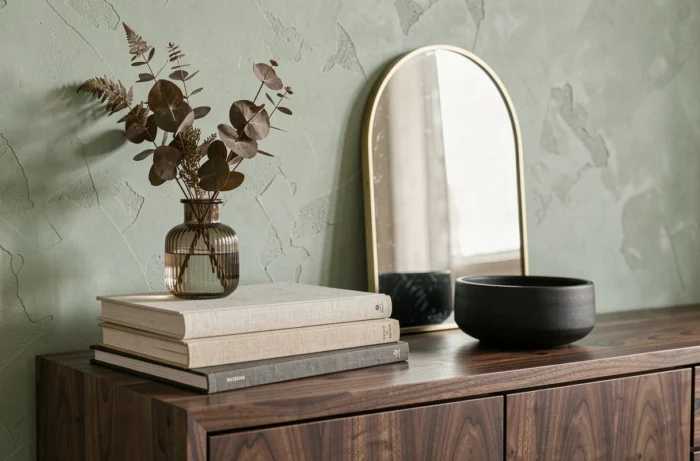
Lime accompanies this movement. Used as a wall coating, it produces matte surfaces with a lively texture that capture and diffuse natural light more subtly than conventional paint. Its appearance evolves throughout the day depending on the room’s orientation.
Lime absorbs moisture and gradually releases it, making it a relevant choice in poorly ventilated rooms. This is not just an aesthetic choice: the finish serves a technical function of hygrometric regulation, particularly suited to old constructions.
Modular Furniture: Designing an Interior That Changes Function
The modularity of furniture goes beyond being a trend to become a full-fledged design criterion. Manufacturers offer systems of sofas, shelves, and tables whose elements can be reconfigured without tools or additional purchases.
The challenge is related to lifestyles: occasional telecommuting, a spare room for a child or parent, temporary play space. A modular interior absorbs these variations without renovation. A sofa with detachable modules can free up a passage or create additional seating in just a few minutes.
- Rail shelf systems allow for reorganizing a room’s storage when its function changes, without needing to drill new holes in the wall.
- Extendable tables with sliding tops transition from an individual desk to a table for six, serving the dual function of living room-dining room.
- Glass block partitions, which are on the rise, allow light to flow while delineating a workspace without creating a permanent opaque separation.
This last point deserves special attention. Glass blocks are returning to design projects as an intermediate solution between total openness and solid partitioning. Their translucency preserves the light continuity of a space while providing partial physical and acoustic separation.
Regionalized Colors and Territory-Linked Palettes
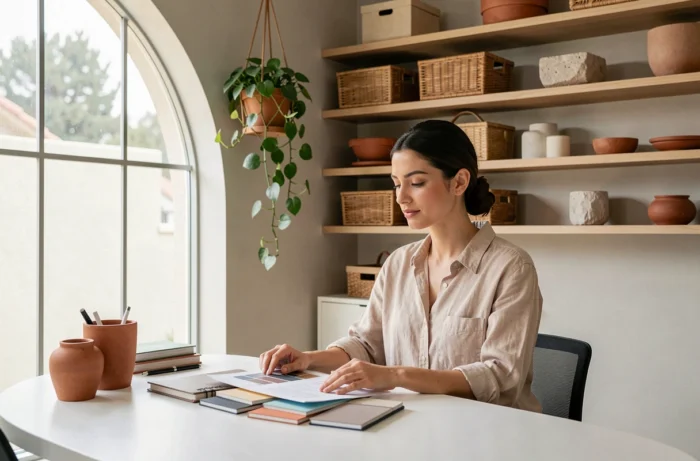
Color choices tend to become regionalized. Rather than a globally imposed color of the year, decor palettes are rooted in shades linked to the territory: southern ochres, bluish grays of the Atlantic coast, deep greens of forested areas.
This approach changes the selection method. Instead of choosing a shade from a standardized color chart, the color is decided based on local light and surrounding materials. A terracotta functions differently in a sun-drenched Provençal home than in a north-facing Parisian apartment.
How to Implement This Approach at Home
The principle is to start from what already exists in the immediate environment. The exposed stone of a wall, the shade of the flooring, the dominant color of the landscape seen from the main window: these elements serve as a starting point rather than a generic color chart.
Matte finishes and natural textures (linen, boucle wool, raw wood) reinforce this territorial coherence. They avoid reflections that standardize color perception and allow nuances to express themselves according to the hour and season.
This year’s decor trends converge towards less fixed interiors, where regulations on reuse, the return of artisanal know-how, and the modularity of furniture create a habitat capable of evolving with its occupants. Color itself ceases to be an arbitrary choice and becomes a response to a specific geographical context.