
Le Vésinet has three train stations on the RER A line: Le Vésinet-Le Pecq, Le Vésinet-Centre, and Chatou-Croissy on the southern edge. For a town of this size, this service is unusual. It structures the local real estate market in a more complex way than a simple gradient of “close to the station = more expensive”.
Proximity of RER A to Le Vésinet: a very uneven price premium depending on the neighborhoods
Competitors readily display an average municipal price of around €7,000 to €7,800/m². This figure masks considerable disparities within the city itself.
Recent listings show that houses located five to seven minutes on foot from the Le Vésinet-Le Pecq or Le Vésinet-Centre stations are listed between €6,200 and €7,300/m². In the Merlettes neighborhood, about a kilometer from the nearest station, a property was offered at around €4,429/m².
The gap exceeds 40% between these two ranges. Attributing this difference solely to the RER would be a mistake: land area, the condition of the building, the standing of the neighborhood, and the presence of private green spaces also play a role. The available data does not allow for precise isolation of the transport’s contribution to price formation. No recent public study rigorously quantifies this “RER premium” in Le Vésinet.
What can be observed is that the immediate proximity of a station remains a strong valuation argument in listings, systematically used by agencies to justify high prices. When looking to buy a house in Le Vésinet, the actual walking distance to the station deserves to be verified on the ground, not just on a map.
Door-to-door travel time to Paris: the gap between promise and reality
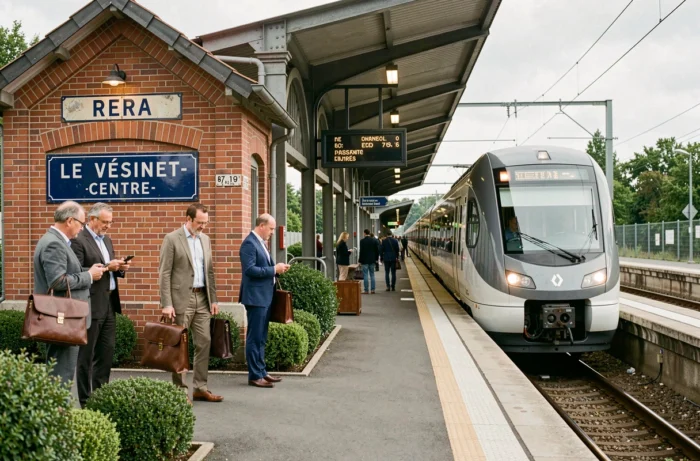
Commercial brochures announce “Paris in 25 minutes” from Le Vésinet. This time corresponds to the journey on RER A to Châtelet-Les Halles, without service interruption. It does not take into account the walking time to the station, nor any potential transfers upon arrival.
A property located in the Ibis sector, to the south of the town, is advertised as being thirteen minutes on foot from the Chatou-Croissy station. Another, in the southern sector near the RER, indicates five to seven minutes of walking. The actual “door-to-door” time varies from 30 to 45 minutes depending on the departure neighborhood and the final Paris destination.
For a buyer working in La Défense, the situation changes: the RER A journey is shorter (about twelve minutes from station to station). This factor partly explains why Le Vésinet attracts a clientele of executives working in the business district, and not just Parisian residents.
The station used is not always the closest as the crow flies
The layout of the streets in Le Vésinet, inherited from its 19th-century landscape plan with its winding roads, lakes, and wooded islets, extends the actual distances. A property located 600 meters from a station may require ten minutes of walking due to the route imposed by the road network.
Before comparing two houses based on their proximity to the RER, it is essential to trace the actual walking route and identify the station that can be used daily. This verification sometimes changes the profitability calculation of a purchase.
Real estate market in Le Vésinet in 2026: what average prices do not reveal
Le Vésinet remains a town where houses represent about 85% of the residential stock. The apartment market exists, but it remains minority and concentrated near the town center. This atypical structure makes average price per m² unreliable for guiding a purchasing decision.
Several factors create significant disparities within the town:
- The land area, which can range from a few hundred square meters to over half a hectare for the largest properties, with a direct impact on the total price
- The architectural type (early 20th-century stone houses, 1960s pavilions, contemporary construction), each attracting a different clientele and distinct price levels
- The presence or absence of overlooking, related to the vegetation density of the neighborhood and the size of neighboring plots
- The general condition of the property and the amount of work required, with the average negotiation in the town being between 3% and 5% according to feedback from local agencies
Old apartments, often in Art Deco buildings or small co-ownerships near the RER, are negotiated within a narrower range. In contrast, for houses, two properties on the same street can show a price gap of over 30% depending on the land and condition.

Real estate prices and RER A: visible correlation, unproven causality
The temptation is strong to draw a curve linking distance to the station and price per m². Listings seem to confirm this logic: the farther you are, the cheaper it gets. The problem is that the neighborhoods close to the Le Vésinet stations are also the most central, best maintained, and most sought after for reasons other than transport.
The RER A functions here as a marker of centrality as much as a mobility tool. No published data allows for the separation of the transport effect from the neighborhood effect in the formation of prices in Le Vésinet.
For a buyer, the practical consequence is clear: paying more “for the RER” often means paying more for a set of characteristics (proximity to shops, tree density, quality of construction) of which transport is just one component. A property far from the stations but located in a quiet area with a large plot may offer a better surface-price ratio, provided one is willing to accept a daily commute extended by ten to fifteen minutes.
The real estate market in Le Vésinet remains selective, with a limited stock and moderate turnover. The RER A line structures prices, but it does not solely determine them. Verifying the actual walking time, comparing neighborhoods with equivalent amenities, and not relying solely on municipal averages remains the most reliable method for calibrating one’s budget in 2026.