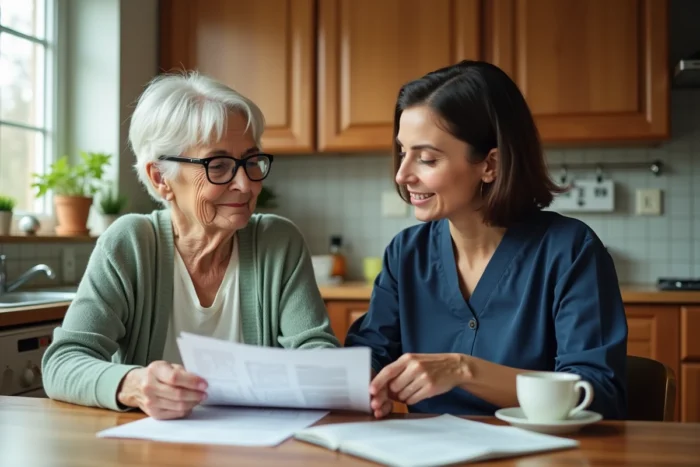
When you start looking for help for a parent who struggles to prepare their meals or who hasn’t left the house for weeks, you quickly come across a mass of information scattered between institutional websites, local associations, and private platforms. Sorting through it takes time, and needs do not wait.
Services dedicated to seniors today cover a wide spectrum, from home intervention to digital support, but one must know where to start and which services correspond to a specific situation.
Senior and Caregiver Houses: the One-Stop Shop Few Seniors Know About
Before making multiple calls between the town hall, the CCAS, the pension fund, and the department, you can save time by going through a Senior and Caregiver House (M2A). These structures, which have been deployed more rapidly since 2023 in several departments, gather under one roof information about home services, psychological support for caregivers, prevention workshops, and administrative assistance.
Specifically, the M2A functions as a single territorial entry point. They assess the overall situation of the elderly person: level of autonomy, housing, family support, resources. Based on this assessment, a contact person directs you to the right interlocutors without having to repeat the explanation at each counter.
To identify existing structures near you, the services offered by Magazine Seniors help locate available resources based on your location and situation.
Home Help for Seniors: Choosing Between Service Provider Mode and Direct Employment
The question arises as soon as one considers regular home intervention. You can go through a Home Help and Support Service (SAAD) in service provider mode, or directly hire an intervenor in direct employment. The two options do not involve the same responsibilities or costs.

Service Provider Mode: The Structure Manages Everything
The SAAD recruits, trains, and pays the intervenor. You receive a monthly bill, and it is the service that ensures replacement in case of absence. The service provider mode is suitable when you do not want to manage payroll or employer obligations.
Feedback varies on this point: some families find that the rotation of intervenors harms the trust relationship with the senior, while others appreciate the flexibility in case of unforeseen events.
Direct Employment with CESU
You become the employer, which gives you more control over the choice of the person and the hours. The CESU (Universal Service Employment Check) simplifies declarations, but you remain responsible for the employment contract, leave, and potential dismissal.
This mode works well when the senior has identified a trustworthy person in their neighborhood or through word-of-mouth. In case of heavier needs (bathing, transfers), it is better to ensure that the intervenor has the required qualifications.
Teleassistance and Connected Tools: What Has Changed for Staying at Home
The classic alert pendant remains useful, but the offer has expanded. Current teleassistance devices integrate automatic fall detection, geolocation for disoriented individuals, and sometimes motion sensors installed in the home that signal a break in routine (no bathroom visits for several hours, front door not opened all day).
These sensors do not replace human presence, but they fill in the gaps without an intervenor. For a senior living alone at night, this is often the device that reassures the family the most.
The Digital Package Offered by Some Pension Funds
Several pension funds, such as CARSAT Bourgogne-Franche-Comté, have been experimenting since 2024 with specific aids to finance tablets, adapted smartphones, and digital support for those over 60. These programs, integrated into actions to prevent loss of autonomy, go beyond simple introductory workshops:
- Partial coverage of equipment (tablet or smartphone with simplified interface)
- Internet connection package included for a specified period
- Individual in-home support for familiarization, with a trained intervenor
The goal is to combat digital isolation, which particularly affects seniors far from urban centers. Making an appointment with a specialist, tracking health reimbursements, calling grandchildren via video: these everyday actions become accessible when the tool is adapted and someone takes the time to explain it.
Funding for Senior Services: APA and Complementary Aids
The Personalized Autonomy Allowance (APA) remains the main funding lever for people experiencing loss of autonomy. It is provided by the department, and its amount depends on the level of dependency assessed according to the AGGIR grid (GIR 1 to 4). The APA at home covers part of the expenses related to human assistance, technical aids, and sometimes housing adaptations.
What is often forgotten are the complementary aids that can be combined:
- Assistance for returning home after hospitalization (ARDH), provided by pension funds, which temporarily finances a housekeeper or meal delivery
- Aids from mutual insurance and complementary funds, varying according to contracts, for teleassistance or housing adaptation
- Tax credit for employing a home worker, which covers half of the expenses incurred within an annual limit
- Aids from local authorities (municipalities, intercommunalities) for accompanied transport or social connection activities
Combining these provisions can significantly reduce out-of-pocket expenses, but they must be requested separately from each organization. The M2A or the CCAS of your municipality can help with compiling the files.
Activities and Social Connection: Services Often Underestimated
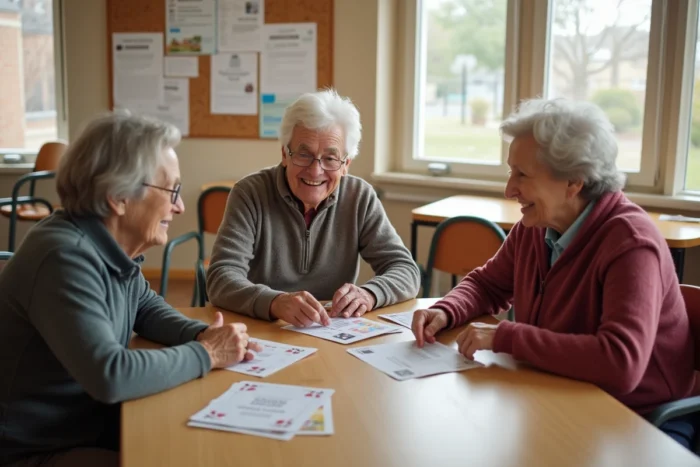
Staying at home is not limited to physical assistance. Isolation is an aggravating factor for loss of autonomy, and several services specifically target social connection: group memory workshops, accompanied outings, volunteer visits through associations like the Claude Pompidou Foundation or the Little Brothers of the Poor.
These interventions have a direct impact on health and morale. A senior who participates in a regular collective activity maintains their cognitive abilities and desire to take care of themselves better.
Establishing effective support for a senior rarely relies on a single service. It is the combination of home help, safety tools, administrative support, and socialization activities that produces a lasting result. Taking the time to identify each need, then reaching out to the right interlocutors, remains the most reliable approach to concretely improve daily life.